
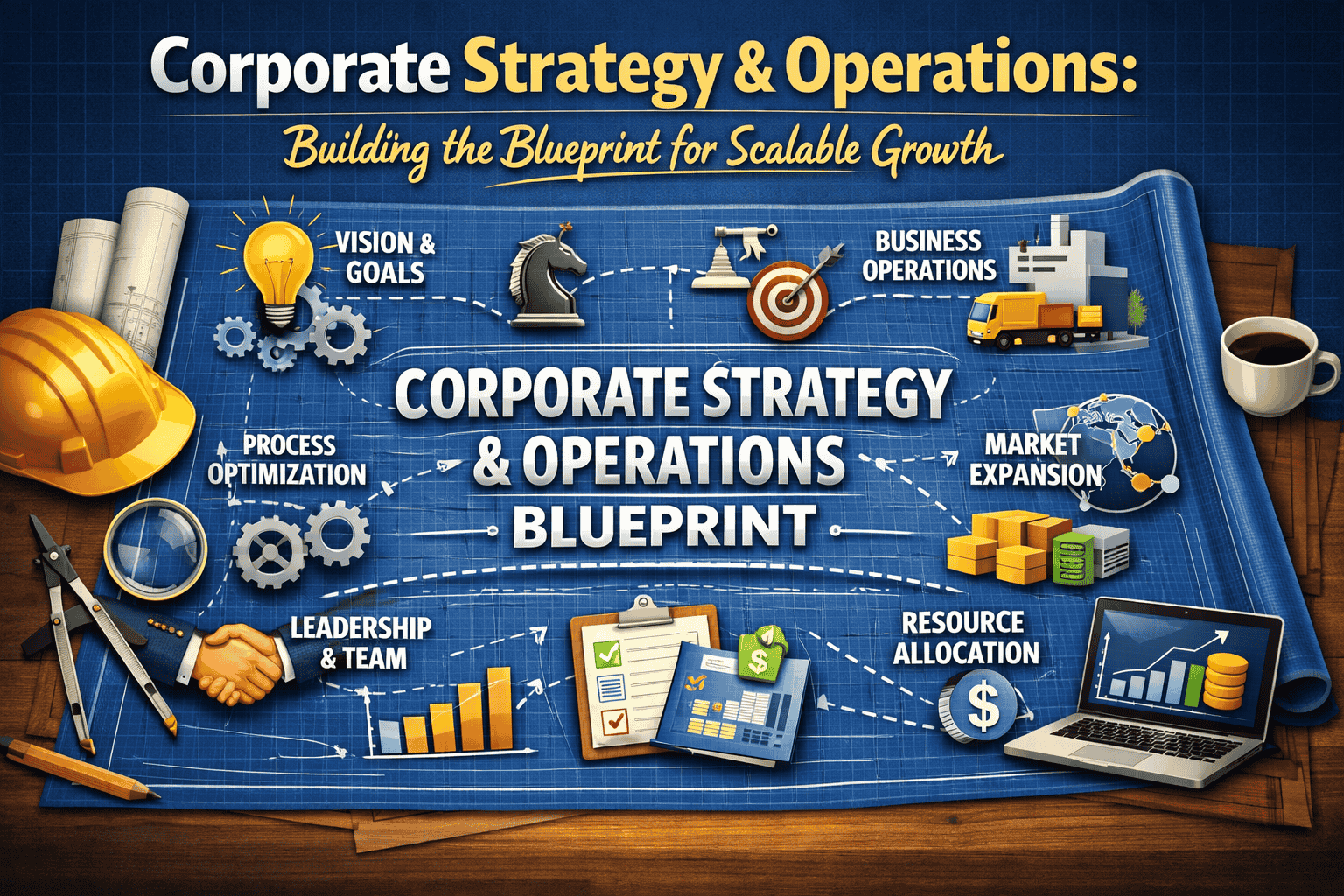
In the fast-paced modern business landscape, many organizations treat "strategy" and "operations" as two entirely separate entities. Executive leadership teams spend weeks crafting high-level corporate strategies behind closed doors, while operational managers focus strictly on day-to-day execution on the ground.
However, when a company fails to hit its growth milestones, it is rarely due to a poor strategy or a lazy workforce. Instead, it is almost always caused by a structural disconnect between the two—a failure to translate corporate vision into daily operational execution.
To build a truly scalable business, you must treat Corporate Strategy and Operations as a unified engine. This guide provides a comprehensive framework to align your high-level goals with your daily workflows.
What Is Corporate Strategy?
Corporate strategy is the highest level of strategic decision‑making. It answers questions such as:
- Which industries or markets should we compete in?
- How should we allocate capital across business units?
- Should we grow organically, through acquisitions, or via partnerships?
- What is our portfolio mix (cash cows, stars, question marks, dogs)?
- BCG Matrix – allocates resources based on market growth and relative market share.
- Ansoff Matrix – maps growth strategies (market penetration, product development, market development, diversification).
- Porter’s Five Forces – analyzes industry attractiveness.
- Value Chain Analysis – identifies where a company creates competitive advantage.
What Is Operations Management?
Operations management focuses on the processes that produce and deliver a company’s products or services. It answers questions such as:
- How do we produce goods or deliver services efficiently?
- How do we manage inventory, supply chains, and logistics?
- How do we maintain quality while controlling costs?
- How do we respond to fluctuations in demand?
- Lean management – eliminating waste (Toyota Production System).
- Six Sigma – reducing variation and defects.
- Supply chain management – coordinating suppliers, production, and distribution.
- Capacity planning – matching output to demand.
- Process improvement – using methodologies like Kaizen, DMAIC, or PDCA.
The Strategy-Operations Gap: Why It Happens
Despite their deep interdependence, strategy and operations often become disconnected in the corporate world. When this gap forms, strategy quickly devolves into mere "pictures on a wall," while operations sinks into a perpetual "firefighting mode," causing the entire organization to drift aimlessly.
This critical breakdown typically happens due to five common organizational failures:
- Communication Breakdown: A major disconnect occurs when strategy is treated as a static event. It is communicated once a year during a big meeting and then promptly forgotten, leaving operations teams completely in the dark when real-time priorities shift.
- Misaligned Incentives: Friction arises when corporate goals conflict with daily rewards. For example, operational bonuses might be strictly tied to cutting costs, even though the broader corporate strategy demands heavy investment in building new capabilities.
- Different Time Horizons: Teams naturally operate on completely different clocks. While strategists look ahead and think in terms of years, operators are focused on immediate execution and think in hours. Because of this gap, neither side truly appreciates or understands the other’s sense of urgency.
- Siloed Data: A lack of shared information prevents collaboration. The strategy team builds its models using high-level market reports, while the operations team manages daily workflows using real-time production data. Without a shared dashboard, they are looking at two entirely different realities.
- No Feedback Loop: When the frontline operations team discovers that a new strategic initiative is physically or technically impossible to execute, the system fails if they have no clear channel or voice to raise the issue back to leadership.
How to Align Corporate Strategy and Operations
Closing the gap requires deliberate design. Below are five proven practices that high‑performance organizations use to keep strategy and operations in lockstep.
1. Cascade Strategy into Operational Goals
Strategy begins at the top, but it must cascade down to individual contributors. The most effective method used by modern enterprises is the Objectives and Key Results (OKR) framework.
- Corporate Objectives: High-level, qualitative goals set by executive leadership (e.g., "Expand market share in Western Europe").
- Operational Key Results: Quantitative, measurable milestones assigned to departments (e.g., "Localize platform infrastructure into French and German by Q3").
2. Standard Operating Procedures (SOPs)
An aligned objective is useless if your team doesn’t know how to execute it uniformly. Documenting your workflows through standardized outlines is the single most effective way to eliminate operational friction.
- Implementation: Every critical task—from customer onboarding to server deployment—must have a step-by-step SOP outline. This ensures quality control and allows new employees to scale up without constant supervision.
3. Establish a Continuous Strategy-Operations Rhythm
Strategy should never be a once-a-year presentation that gets shelved. Instead, build a predictable, recurring cadence that continuously links daily work to long-term goals:
- Weekly Operations Reviews: Focus on immediate metrics like production outputs, logistics, and quality control to flag and fix any sudden deviations from the plan.
- Monthly Alignment Meetings: Bring strategy and operations leaders together to directly evaluate if current operational performance is pacing toward strategic milestones.
- Quarterly Strategy Reviews: Actively adjust corporate priorities and resource allocation based on real-world operational limitations or successes.
- Annual Strategic Planning: Execute a full macro-level planning cycle that is heavily backed and informed by a year’s worth of concrete operational data.
4. Build Shared Dashboards and Unified Metrics
When executives and managers look at different data streams, they end up having entirely different conversations. To fix this, create a single source of truth across three layers:
- The Executive Dashboard: A high-level view for leadership tracking long-term milestones.
- The Manager Dashboard: A real-time view for operators monitoring efficiency, throughput, and daily quality.
- The Shared Scorecard: A bridge that explicitly links a daily operational metric to a massive strategic outcome.
5. Connect Frontline Roles to the Strategic Context
Frontline supervisors and employees usually have the best ideas for process optimization, but they rarely understand how their work moves the company’s needle. Connect them to the larger vision by taking three steps:
- Explain the *Why*: Always include a brief, clear explanation of the strategic goal inside every Standard Operating Procedure (SOP).
- Align the Huddles: Start daily operational stand-ups with a quick, five-minute update on corporate strategy before diving into tactical tasks.
- Reward Aligned Innovation: Recognize and incentivize employees who propose process improvements that directly match your current strategic priority—such as rewarding a cost-cutting idea if the business is pursuing a low-cost leadership strategy.
6. Unify Planning and Financial Budgeting
Running separate strategic planning sessions and operational budgeting meetings is a guaranteed recipe for misalignment. Companies should adopt Integrated Business Planning (IBP) or Sales and Operations Planning (S&OP). This framework binds five critical elements into a single monthly review:
- Strategic growth targets (revenue and market share)
- Real-time sales forecasts
- Actual production capacity
- Inventory levels
- Financial and departmental budgets
Optimizing the Value Chain
To maximize profitability, operational workflows must be systematically audited using a Value Chain Analysis. This separates your company’s activities into primary and support operations to find inefficiencies.
Primary Operations
These are the frontline activities that directly create, sell, and support your core product:
- Inbound Logistics: Managing incoming raw data, software assets, or physical inventory.
- Operations/Production: Turning inputs into the final, functional user output.
- Outbound Logistics: Distributing the final product to users or digital marketplaces.
- Marketing & Sales: Acquiring users and driving conversions.
- Customer Service: Enhancing user retention through continuous technical support.
Support Operations
These are the structural backbones that allow your primary operations to run smoothly:
- Procurement: Sourcing software vendor licenses, cloud servers, or hardware.
- Technological Development: Maintaining a modern, secure, and automated tech stack.
- Human Resources: Hiring, onboarding, and training top-tier talent.
Common Pitfalls (And How to Avoid Them)
| Pitfall | Avoidance Tactic |
|---|---|
| Strategy is too vague | Use concrete, quantifiable objectives (“increase gross margin by 3 points” not “improve profitability”). |
| Operations resists change | Involve operations leaders in strategy creation. They will own what they help create. |
| No consequence for misalignment | Tie executive compensation to both strategic milestone achievement and operational efficiency metrics. |
| Data overload | Limit shared dashboards to 5–7 critical metrics. Everything else is secondary. |
| Short‑term crisis overrides strategy | Build a “strategic reserve” (time and budget) that cannot be cannibalized for firefighting. |
Tools & Frameworks at a Glance
| Tool | Best For |
|---|---|
| Balanced Scorecard | Translating strategy into operational metrics across four perspectives. |
| Hoshin Kanri (Policy Deployment) | Aligning every employee’s daily work with annual strategic objectives. |
| Value Stream Mapping | Identifying waste and bottlenecks in operational processes that block strategic goals. |
| Strategy Maps | Visualizing cause‑and‑effect relationships between strategic objectives and operational drivers. |
| S&OP / IBP | Integrating sales, operations, and finance into a single planning process. |
Conclusion
Corporate Strategy and Operations are not competing paradigms; they are two sides of the same coin. A brilliant strategy without strong operations results in a stagnant business that cannot execute. On the other hand, hyper-efficient operations without a clear strategy leads to an organization moving quickly in the wrong direction.
By designing clear, structured outlines for your workflows and aligning your daily metrics with your long-term goals, you create an agile business model capable of scaling across borders and industries.