
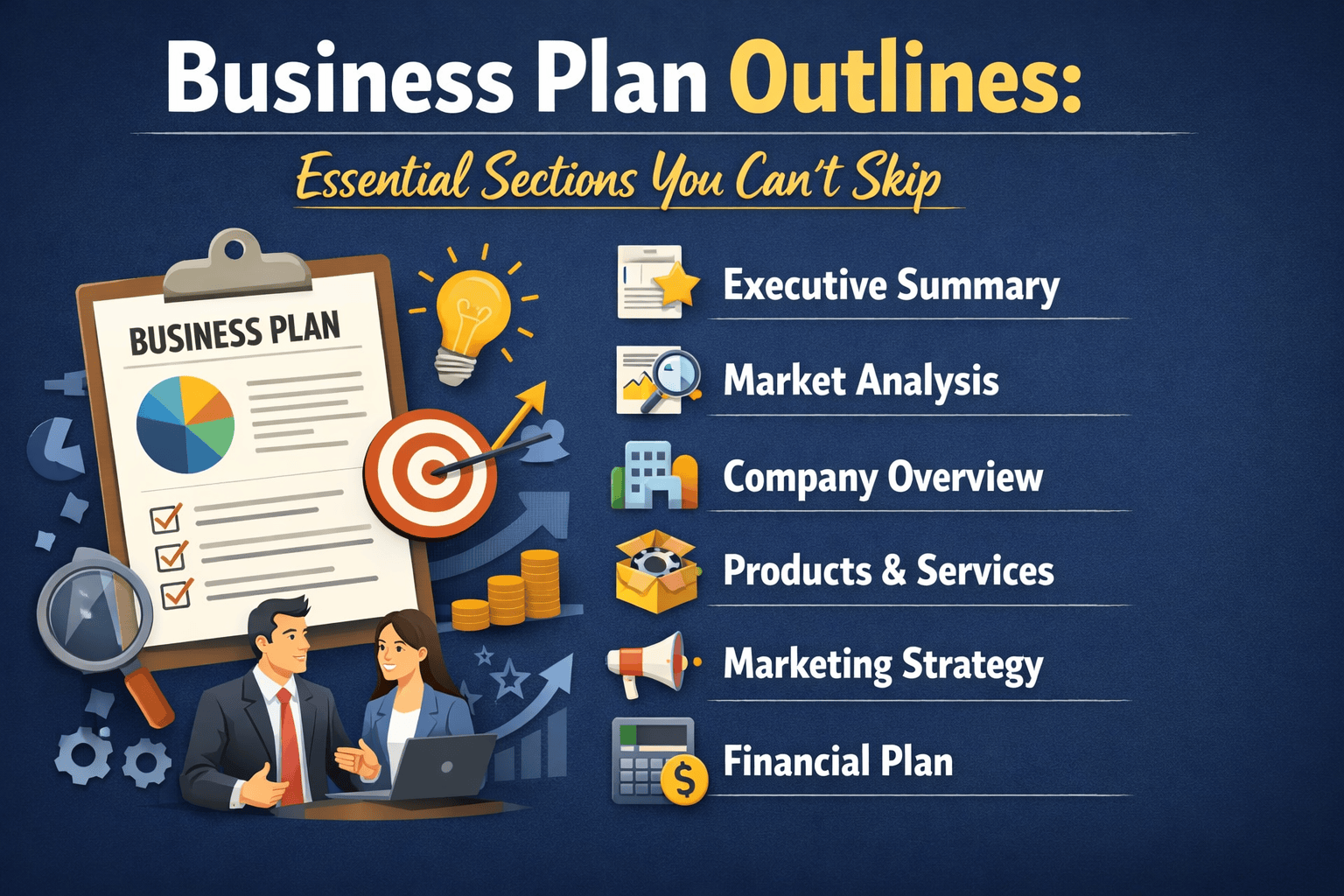
Writing a business plan can feel like an overwhelming task. Many entrepreneurs get bogged down in deep financial forecasting or lengthy market analysis before they even define their core value proposition. However, a business plan isn’t just a document you create to secure a bank loan or impress investors—it is the operational roadmap for your company’s future.
When business plans fail to win approval or guide a company successfully, it is rarely due to a lack of passion. Instead, it is usually because the document skips critical foundational pillars, leaving holes in the execution strategy.
Using a standardized business plan outline ensures that you address every vital corporate question upfront, translating your vision into a practical, risk-mitigated blueprint.
The Golden Rule: Tell a Cohesive Story from Start to Finish
Before diving into the sections, understand the narrative arc of a winning business plan:
- We see a clear problem → Our product solves it uniquely → The market is large and growing → We already have traction → Our business model is sound → We will execute through a proven strategy → We have the right team → Here is exactly what we need to go further.
The 9 Essential Sections (No Exceptions)
A complete business plan balances high-level commercial vision with granular operational realities. To achieve maximum impact, ensure your document includes these nine non-negotiable sections:
1. The Executive Summary
The executive summary is the gateway to your entire business plan. Although it appears first in the final document, it should always be written last.
Purpose: Capture attention and summarize the entire plan in one or two pages. Many investors read only the executive summary first. If it fails to impress, they never open the rest. Write it last, but place it first. It must include:- Mission statement (one sentence: who you are and what you do).
- The problem and your solution (two to three sentences).
- Target market and opportunity size (high‑level TAM/SAM/SOM).
- Business model (how you make money).
- Traction to date (revenue, users, partnerships, patents – any proof).
- Financial highlights (current and projected revenue, profitability timeline).
- The ask (how much funding you need and how you will use it).
2. Company Overview (or Company Description)
Purpose: Establish who you are, your history, and your legal structure. This section humanizes your business. It answers: Where did you start? Where are you now? Must include:
- Legal name, location, and entity type (LLC, C‑corp, partnership, etc.).
- Brief history (founding date, key milestones, pivots).
- Mission, vision, and core values (short, not corporate jargon).
- Legal and ownership structure (founders, major shareholders).
- Operating locations (offices, warehouses, retail stores).
3. Problem & Solution (Sometimes split into two sections)
Purpose: Make the reader feel the pain of your target customer, then show relief. Investors do not fund features; they fund solutions to urgent, valuable problems. Must include:
- Description of the problem – use data, anecdotes, or customer quotes. Be specific: “Small retailers lose $10,000 annually to inventory shrinkage.”
- Who experiences it – demographic, firmographic, or psychographic profile.
- Consequences of ignoring the problem – lost revenue, wasted time, safety risks.
- Your solution – what it is, how it works, and why it is superior to alternatives.
- Unique value proposition (UVP) – one sentence that captures your differentiation.
4. Market Analysis
Purpose: Prove that a substantial, reachable market exists and that it is growing (or underserved). A great product in a tiny market will never return investor capital. Show the numbers.
Must include:
- Industry overview – size, growth rate, trends (source your data: Gartner, IBISWorld, Statista).
- Target market segmentation – break down your ideal customer personas (e.g., “urban millennial parents with household income >$80k”).
- TAM, SAM, SOM (Total Addressable Market, Serviceable Addressable Market, Serviceable Obtainable Market). Explain how you calculated each.
- Market need – why existing solutions fall short (regulatory gaps, technological shifts, changing consumer behavior).
- Regulatory or environmental factors – if relevant (licensing, compliance, seasonality).
5. Competitive Analysis
Purpose: Show that you know your rivals and have a sustainable advantage. Saying “we have no competition” is an instant credibility killer. Every business has competitors—direct, indirect, or substitute.
Must include:
- List of direct competitors (same solution, same customer).
- List of indirect competitors (different solution, same problem).
- Competitive matrix (2×2 grid or table) comparing features, pricing, target audience, distribution, and USPs.
- Your sustainable competitive advantage – technology, network effects, brand, cost structure, patents, exclusive partnerships.
- Barriers to entry for would‑be copycats.
6. Products & Services (or Technology)
Purpose: Explain exactly what you sell, how it is delivered, and why customers will love it. Move beyond the “solution” slide. This section dives into the practical details.
Must include:
- Product/service description – features, specifications, intellectual property (patents, trademarks, trade secrets).
- Development stage – idea, prototype, beta, launched, scaling.
- Product roadmap – next 12–24 months of major releases or improvements.
- Manufacturing or delivery model – how you produce or fulfill (in‑house, outsourced, dropshipped).
- Customer support and warranty policies (if applicable).
7. Marketing & Sales Strategy
Purpose: Detail your go‑to‑market plan and how you will acquire customers cost‑effectively. A brilliant product that cannot reach buyers is worthless. Investors want to see a realistic, scalable customer acquisition engine.
Must include:
- Customer acquisition channels – list 3–5 primary channels (e.g., SEO, paid social, field sales, partnerships). For each, state expected CAC (Customer Acquisition Cost).
- Marketing tactics – content marketing, events, influencer programs, PR.
- Sales process – lead generation → qualification → proposal → closing. Include sales cycle length and average deal size.
- Sales team structure – inside sales, outside sales, channel partners, self‑service.
- Customer retention strategy – loyalty programs, account management, upselling.
- Key metrics – CAC, LTV (Lifetime Value), payback period, churn rate.
8. Management Team & Organization
Purpose: Prove that the people behind the plan can execute it. Investors often say they “bet on the jockey, not the horse.” This section is your chance to shine.
Must include:
- Founders and key executives – names, titles, photos, short bios.
- Relevant experience – previous startups, industry expertise, operational wins.
- Advisory board or board of directors – if they add credibility.
- Organizational chart – showing reporting lines and planned hires.
- Staffing plan – current headcount and open roles for the next 12–18 months.
- Any gaps – honesty about missing expertise builds trust (e.g., “We plan to hire a CTO within six months”).
9. Financial Funding and Projections
Purpose: Present historical data (if any) and realistic projections that show a path to profitability. This is where many plans fall apart. Unsubstantiated hockey‑stick growth kills credibility. Be conservative but confident.
Must include (for established businesses):
- Historical financials – 3 years of P&L, balance sheet, cash flow (if applicable).
- Assumptions – list every key driver (customer growth rate, churn, seasonality, price changes, hiring plan).
- Projected P&L – 3 to 5 years forward (monthly for first year, quarterly thereafter).
- Cash flow statement – critical for startups (many fail due to running out of cash, not lack of sales).
- Balance sheet (optional for very early stage, expected for later rounds).
- Break‑even analysis – when will you cover all costs?
- Pro‑forma financials based on realistic unit economics.
- Use of funds – a pie chart showing exactly how you will spend the raised capital.
- Runway – how many months until you need next funding.
Common Mistakes to Avoid
| Mistake | Why It’s Fatal |
|---|---|
| Too long | 50+ pages = no one reads it. Aim for 15–25 pages (plus appendix). |
| Unrealistic projections | 500% market share in year one? Investors will laugh. |
| Ignoring competition | Assumes the worst: you haven’t done your homework. |
| No clear ask | If you don’t say exactly what you need, you won’t get it. |
| Over‑reliance on jargon | “Leverage synergistic paradigms” says nothing. Use plain English |
| Spelling/grammar errors | Sloppy plan = sloppy management. |
| Missing financial assumptions | Numbers without assumptions are meaningless. |
Conclusion
A business plan is not a static document you write once and file away. It is a living tool for fundraising, hiring, and strategic alignment. But no matter how often you update it, the essential sections remain the same: executive summary, company overview, problem & solution, market analysis, competitive analysis, products, marketing & sales, team, financials, and the ask.
Skip any of these, and you leave a critical question unanswered. Answer them all with clarity, data, and honesty, and you transform your idea from a dream into a compelling investment case.