
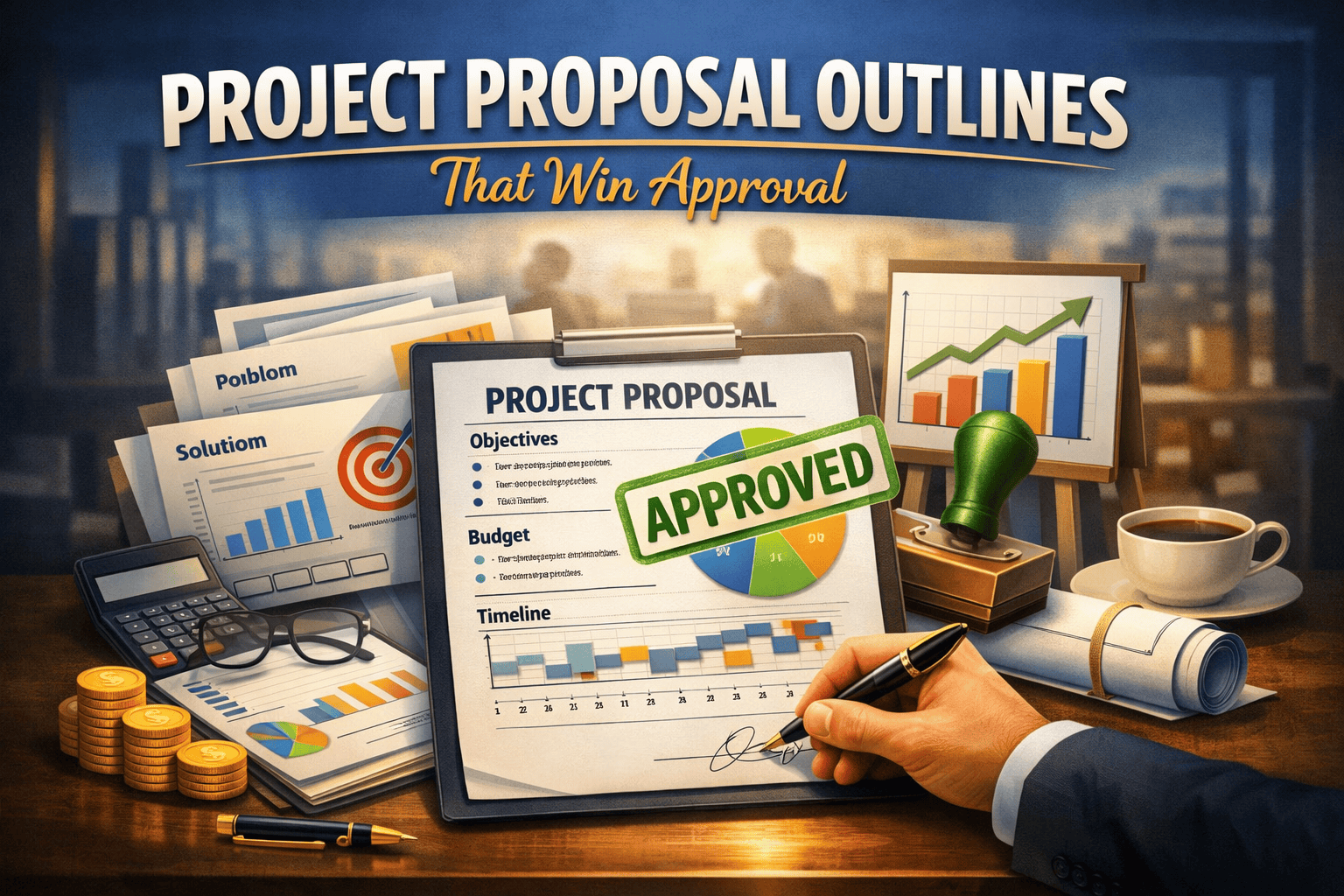
In any professional environment, a brilliant idea is only half the battle. The other half is securing the budget, resources, and stakeholder buy-in required to bring that idea to life. Whether you are proposing an internal software upgrade, a client-facing marketing campaign, or a multi-million dollar infrastructure project, your success depends heavily on your initial proposal.
When decision-makers reject a proposal, it is rarely because the core idea is bad. Instead, it is usually because the document lacks a clear structure, leaving stakeholders confused about the exact costs, timelines, and measurable returns.
Using a standardized project proposal outline ensures you address every critical business question upfront, transforming a vague concept into a risk-mitigated plan.
Below is the proven, step‑by‑step outline that successful project managers and consultants use to win approval, whether for internal projects, client work, or grant funding.
The Golden Rule: Answer the Unspoken 5 Questions
Every reviewer is silently asking:
- What problem does this solve? (Is it worth solving?)
- What is your solution? (And why is it better than alternatives?)
- How will you do it? (Plan, timeline, resources.)
- What will it cost? (Budget, risks, ROI.)
- Why you? (Credentials and credibility.)
The Standard 10‑Section Proposal Outline
Tailor this to your audience, but never skip a section without a good reason.
1. Executive Summary
This is the only part many executives will read in full. Write it last, but place it first.
- One sentence stating the project’s purpose.
- One paragraph on the problem and your solution.
- Key outcomes (quantified: “reduce processing time by 40%”).
- Total cost and timeline (high level).
- The ask (approval, budget, resources).
2. Problem Statement (or Opportunity Statement)
Establish urgency. Describe the current state (pain, inefficiency, missed revenue) and why ignoring it is more costly than acting.
- Use data, quotes, or a short case study.
- Avoid vague complaints (“communication is poor”). Instead: “Internal survey shows 12 hours per week lost to manual data reconciliation across three departments.”
- If this is an opportunity (e.g., new market), show the potential gain in dollars or strategic advantage.
3. Proposed Solution / Objectives
This section clarifies exactly what the project will accomplish. Avoid vague promises and instead use the SMART framework.
- Specific: Clearly state what you want to achieve.
- Measurable: Define how you will measure success.
- Achievable: Ensure the goal is realistic given your resources.
- Relevant: Align the project directly with broader company or client strategies.
- Time-bound: Set a definitive deadline for completion.
4. Scope – What’s In and What’s Out
Scope creep kills projects and trust. Clearly define boundaries.
- In scope: Features, departments, locations, phases.
- Out of scope: Explicitly stated to prevent “but you promised” later.
- Assumptions: What you assume to be true (e.g., “IT will provide server access by week 2”).
5. Methodology and Implementation Plan
This is the operational blueprint of your proposal. You must demonstrate how your team will deliver the project from start to finish.
- Phases and Deliverables: Break the project down into manageable stages (e.g., Research, Design, Testing, Deployment).
- Resource Allocation: Specify the tools, technology, and team skill sets required for execution.
6. Timeline & Milestones
Show when things will happen. A Gantt chart or a simple table works.
Start date, end date (or duration in weeks/months). - Major milestones (e.g., requirements sign‑off, prototype review, pilot launch).
- Dependencies (what must happen before a milestone).Critical path items (if any).
7. Budget and Financial Projections
This is where many proposals fail. You must present a transparent, itemized budget that accounts for all potential expenses.
- One table with categories: Labor, software licenses, hardware, training, travel, contingency (5–15%).
- Payment schedule (for client proposals): upfront, upon milestones, etc.
- Total cost and, if internal, the budget source (department, project code).
- For internal proposals, also include expected savings or revenue to show net benefit.
8. Risk Management and Mitigation
Acknowledge that no project is risk-free. Proactively identifying obstacles proves to stakeholders that you are a realistic and prepared manager.
- Risk Identification: List technical, operational, or financial risks that could delay progress.
- Mitigation Strategy: Detail the exact backup plans you have in place to handle each obstacle if it arises
9. Success Metrics & Evaluation
How will you know the project succeeded? Define this up front.
- Quantitative metrics (e.g., “User adoption >80% within 3 months”, “Response time under 2 seconds”).
- Qualitative metrics (stakeholder satisfaction survey).
- Reporting frequency (weekly status, monthly steering committee).
- Who measures and how.
Avoid These Killer Mistakes
- No clear “ask” – If you don’t explicitly say “Approve $50,000 and assign two developers,” you won’t get it.
- Over‑promising – Unrealistic deadlines or 300% ROI claims destroy credibility.
- Too much technical detail – Save the wiring diagrams for the appendix.
- Ignoring the audience’s priorities – A CFO cares about ROI and risk; a CTO cares about feasibility; an HR director cares about team load. Address each.
- Typos and inconsistent formatting – Sloppy proposal = sloppy project.
Conclusion
A winning project proposal does not rely on emotional appeals; it wins approval through logical organization, data-driven evidence, and clear milestones. By building your next pitch around this seven-part framework, you remove ambiguity and make it incredibly easy for stakeholders to say yes.
A winning project proposal is not a creative writing exercise. It is a structured, persuasive document that respects the reader’s time and answers every unspoken question before it is asked. By following the 9‑section outline above—problem, solution, scope, approach, timeline, resources, budget, risks, metrics, and a clear ask—you transform a vague idea into a compelling case for action.
The best proposals don’t just get approved. They become the foundation for successful projects, aligned teams, and trusting stakeholders.