

In the modern media landscape, the biggest challenge for content marketers and creators isn’t a lack of ideas—it’s a lack of time and strategic clarity. Many marketing departments operate like content mills, frantically writing articles and script drafts based on gut feeling, only to see their assets get buried on page five of search results or ignored on social feeds.
Artificial Intelligence (AI) has completely changed this dynamic. When used correctly, AI is not a tool for lazy automated writing; it is a predictive intelligence engine for your structural planning.
By leveraging machine learning algorithms, creators can analyze massive datasets, accurately map out user search intent, and construct highly optimized content calendars before writing a single sentence. Here is how AI transforms content planning from an unpredictable guessing game into a precise data-driven science.
The AI-Powered Content Lifecycle
An AI-driven content framework shifts your workflow from a linear path (Write, Publish, Hope) into a continuous, data-backed optimization loop.
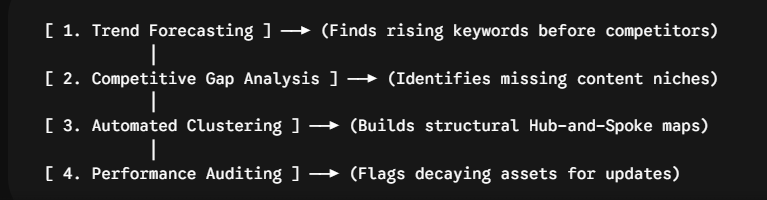
1. Advanced Trend Forecasting & Search Intent Analysis
Traditional keyword tools tell you what happened last month. AI predictive algorithms analyze real-time multi-channel data—including search velocity, social discussions, forums, and regional news loops—to forecast what audiences will care about next quarter.
- Trend Detection & Topic Discovery: Instead of relying on backward-looking data, AI models scan real-time multi-channel search velocity, social discussions, and competitor blogs. You can upload specific competitor URLs, allowing the AI to spot content gaps they have missed entirely.
- From Brief to Creative Direction: AI models can instantly enhance a structural text brief with programmatic asset suggestions, mood boards, and mockup imagery. Providing a comprehensive, multi-modal brief upfront allows creative teams to realize the vision quickly and eliminates repetitive revision cycles.
2. Algorithmic Competitive Gap Analysis
To win organic rankings, you don’t just need more content; you need better-structured answers. AI tools can instantly parse the top 10 competing URLs for a given keyword, reverse-engineer their semantic layout, and map out exactly what they missed.
- Algorithmic Audience Segmentation: Using clustering and topic modeling algorithms, AI analyzes customer behavior patterns to develop distinct content strategies tailored to unique buyer personas, completely avoiding one-size-fits-all messaging.
- Optimizing the Content Mix: Machine learning systems analyze engagement curves to automatically balance value-driven, educational content against high-intent promotional copy. This maintains an optimal, trust-building ratio that keeps unsubscribe and bounce rates low.
3. Automated Content Clustering (Hub-and-Spoke Setup)
As established in high-converting content marketing models, grouping content into structural clusters is essential for SEO. Doing this manually for hundreds of keywords takes weeks. AI turns this into a 10-second task.
- How It Works: Natural Language Processing (NLP) engines evaluate a list of 5,000 keyword variations and instantly group them by semantic relevance.
- The Blueprint: The tool maps out the entire ecosystem: it designates the ultimate master "Hub" topic and creates a clear sequence of supporting "Spoke" articles, complete with internal linking instructions to pass maximum authority across your site.
4. Continuous Content Audits & Decay Prevention
Content planning doesn’t stop once a piece is live. Older assets naturally lose traction as search algorithms evolve and competitors publish updates. AI automates this monitoring process entirely.
- The Guardrail: AI monitoring software integrates with your site analytics to trace the decay curves of your traffic.
- The Triage Plan: Instead of telling you to rewrite everything, the system highlights the exact sections of a specific page that are dropping in relevance, giving your editorial team a clear, high-priority list of precise updates to execute.
The Human Element: What AI Can’t Replace
AI is powerful, but it’s not a substitute for human judgment. The most effective content planning systems treat AI as a collaborator, not an autopilot.
Where Humans Must Stay in Control
- Strategic direction: No one knows your business better than you. Setting objectives should remain firmly in human hands.
- Brand voice and values: AI can produce generic content, but humans ensure originality, attribution, and the authentic voice that distinguishes your brand.
- Editorial judgment: When AI generates ten ideas, humans decide which are worth pursuing.
- Fact-checking and claims: AI handles research and drafts, but humans are responsible for proof and final polish.
The Governance Advantage
The repeatable review and iteration loop becomes a true differentiator—not just publishing more content, but publishing content that’s accurate, on-brand, and trustworthy. AI accelerates good decisions, but it shouldn’t be making them alone.
Human Strategic Oversight vs. AI Capabilities
To deploy AI effectively without losing your unique brand identity or suffering from algorithmic penalties, your creative workflows should clearly divide labor:
| Operational Function | What the AI Handles | Where the Human Expert Rules |
|---|---|---|
| Ideation & Brainstorming | Processing data volumes, pulling FAQs, cross-industry trend analysis | Selecting the unique angle, injecting personal anecdotes, voice consistency |
| Data Structuring | Keyword clustering, semantic grouping, calculating programmatic briefs | Determining business objective alignment, vetting brand safety |
| Performance Tracking | Scraping metrics, tracing traffic decay, spotting SEO site health errors | Navigating overall business pivots, final strategic decision-making |
The Bottom Line
AI doesn’t replace content planning—it supercharges it. The goal isn’t to publish more for the sake of volume, but to create content that’s smarter, more targeted, and more aligned with what your audience actually needs. By leveraging AI for the repetitive, data-heavy parts of planning, you free your team to focus on the creative and strategic work that makes content truly stand out.
The teams that thrive will be those that find the right balance: AI for speed and efficiency, humans for meaning, nuance, and connection.