

In the high-velocity world of early-stage companies, moving fast is a requirement—but moving fast in the wrong direction is fatal. Startups frequently fail not because they lack a great product idea, but because they misjudge their market positioning, burn through capital too quickly, or ignore looming regulatory hurdles.
A SWOT Analysis (Strengths, Weaknesses, Opportunities, and Threats) is a foundational framework designed to prevent these blind spots. It forces founders to step away from daily firefighting and look objectively at their business from two distinct viewpoints: Internal Capabilities and External Market Realities.
The Core Structure: Understanding the Four Quadrants
A SWOT analysis is typically formatted as a 2x2 matrix with four quadrants . The left side lists Strengths and Opportunities (positive factors), while the right side lists Weaknesses and Threats (negative factors). But the most important distinction is between internal and external factors:
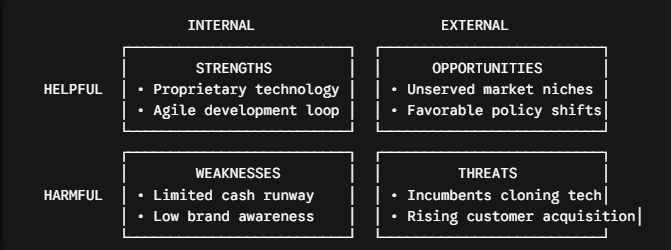
Strengths: What Gives Your Startup an Edge
Strengths are the internal capabilities that give your startup an advantage over competitors . These are things you do exceptionally well — the assets, skills, and resources that set you apart.
Examples of startup strengths:
- Proprietary technology or intellectual property
- A sharp, experienced founding team
- Unique market insights or domain expertise
- Strong investor backing or working capital
- High customer satisfaction or a loyal early user base
- Efficient operations or supply chain advantages
Pro Tip: Anchor your strengths to data, not opinions. A strength shouldn’t be "great product" — it should be a quantifiable metric like a Net Promoter Score (NPS), retention rate, or unit economics figure.
Weaknesses: Understanding Your Vulnerabilities
Weaknesses are internal gaps that limit your progress or create roadblocks . Every startup has limitations — the key is spotting them early so you can manage risk and make smarter decisions.
Examples of startup weaknesses:
- Limited brand awareness as a new market entrant
- Lack of industry experience or business acumen
- Small team or skill gaps in critical areas
- Limited financial resources or high debt
- Operational inefficiencies or weak processes
- Dependence on external factors (like internet access or key suppliers)
Pro Tip: Don’t sugarcoat your weaknesses. Be honest and specific. Prospective lenders and investors will see it as a red flag if you don’t list any weaknesses at all — they understand that no company can be everything to everyone.
Opportunities: Spotting Growth Potential
Opportunities are external factors you can tap into to fuel growth . These are market trends, changes in customer behavior, or untapped niches that align with your mission and capabilities.
Examples of startup opportunities:
- Emerging technologies that complement your product
- Shifting customer behaviors or unmet demand
- Untapped markets or new customer segments
- Strategic partnerships with educational institutions or industry players
- Government support or favorable regulatory changes
- Growing trends in your industry
Pro Tip: Before acting on an opportunity, make sure it fits your vision. The wrong opportunity might bring growth, but not the kind you can sustain.
Threats: External Risks to Watch
Threats are external forces that could disrupt your progress or threaten your startup’s future . You can’t control these factors, but you can prepare for them.
Examples of startup threats:
- New competitors entering your market
- Economic downturns affecting customer purchasing power
- Regulatory changes or legal landmines
- Shifting customer preferences away from your offering
- Supply chain disruptions or labor shortages
- Rapid technological changes requiring constant adaptation
Pro Tip: Plan for worst-case scenarios. Based on likelihood and impact, prioritize threats that need immediate action and monitor the rest.
How to Conduct a SWOT Analysis for Your Startup
A SWOT analysis is only as valuable as the quality of the thinking that informs it. Here’s a step-by-step process to ensure your analysis delivers real insights.
Step 1: Assemble the Right Team
To thoroughly evaluate your startup, bring together a mix of founders and key team members who understand the business from different angles. The founding team’s proximity to the business, while an asset, can introduce confirmation bias that distorts the assessment of both strengths and weaknesses. Diverse perspectives help surface insights you might otherwise miss.
Step 2: Define Your Objective
While SWOT can be used for almost any business problem, the most effective analyses are focused on a narrow objective — such as a major branding exercise, a new product launch, or preparing for a funding round. A well-defined objective helps keep the goal in view.
Step 3: Gather Data
Base your analysis on facts, not biases. Gather internal data (financial reports, customer feedback, operational metrics) and external data (market research, industry trends, competitor analysis). The more reliable your information, the stronger your conclusions.
Step 4: Brainstorm Each Category
Using a SWOT template, map your ideas under the four categories. Keep this phase informal to promote creative thinking — no idea is too offbeat or impractical.
Step 5: Prioritize What Matters
Not everything in your SWOT list is equally important. Highlight items with the greatest impact on your short- and long-term strategy. Prioritize by what you can act on now, what needs monitoring, and what might require additional resources later.
Step 6: Turn Insights into Action
Complete your SWOT analysis with an action plan. Look for potential connections between the quadrants of your matrix and figure out what to do next.
Use the TOWS Matrix to generate strategies:
- SO (Strength–Opportunity) strategies: How can you use your strengths to capitalize on your biggest opportunities?
- ST (Strength–Threat) strategies: How can you use your strengths to neutralize or reduce key threats?
- WO (Weakness–Opportunity) strategies: What weaknesses must you address to unlock promising opportunities?
- WT (Weakness–Threat) strategies: Where do your weaknesses magnify threats, and what should you avoid or fix first?
Step 7: Revisit Regularly
A startup’s landscape changes quickly. A SWOT analysis isn’t a one-and-done document — revisit it regularly as things change. Treat it as a living document that evolves with your business.
Common Mistakes to Avoid
Even experienced founders fall into these traps. Watch out for:
- Being too vague in each category: Leads to generic, surface-level insights that are hard to act on.
- Overloading strengths: Creates a false sense of confidence and overshadows real weaknesses.
- Ignoring threats: Prevents early risk mitigation and leaves your startup vulnerable.
- Doing it solo: Limits perspective and misses blind spots that only a team discussion can uncover.
- Stopping at the matrix: A SWOT analysis without an action plan is just a list of observations.
Complementary Frameworks
SWOT is powerful, but it has limitations. Since it’s fundamentally an introspective tool, it doesn’t generate data on its own — it organizes and interrogates what an organization already knows about itself and its environment. Consider using these frameworks alongside your SWOT analysis:
| Framework | What It Covers | How It Helps |
|---|---|---|
| PESTLE | Political, Economic, Social, Technological, Legal, Environmental forces | Deepens the "Opportunities" and "Threats" quadrants |
| Porter’s Five Forces | Supplier power, buyer power, competitive rivalry, threat of substitution, barriers to entry | Sharpens your view of competitive "Threats" |
| Jobs-to-Be-Done (JTBD) | Customer perspectives on functional, social, and emotional outcomes | Addresses SWOT’s blind spot for the customer’s perspective |
Final Thoughts
A well-executed SWOT analysis is one of the most accessible and valuable strategic tools available to startup founders. It doesn’t require expensive consultants or complex models — just honest introspection, reliable data, and a willingness to confront both your strengths and your vulnerabilities.
The Bottom Line: A SWOT analysis forces you to look at your startup from multiple angles. By separating internal reflection from external reality, it gives you a clear, fact-based foundation for strategic decisions. Use it before major milestones — product launches, funding rounds, market entries — and revisit it as your business evolves. The result? Smarter decisions, fewer surprises, and a clearer path to sustainable growth.