
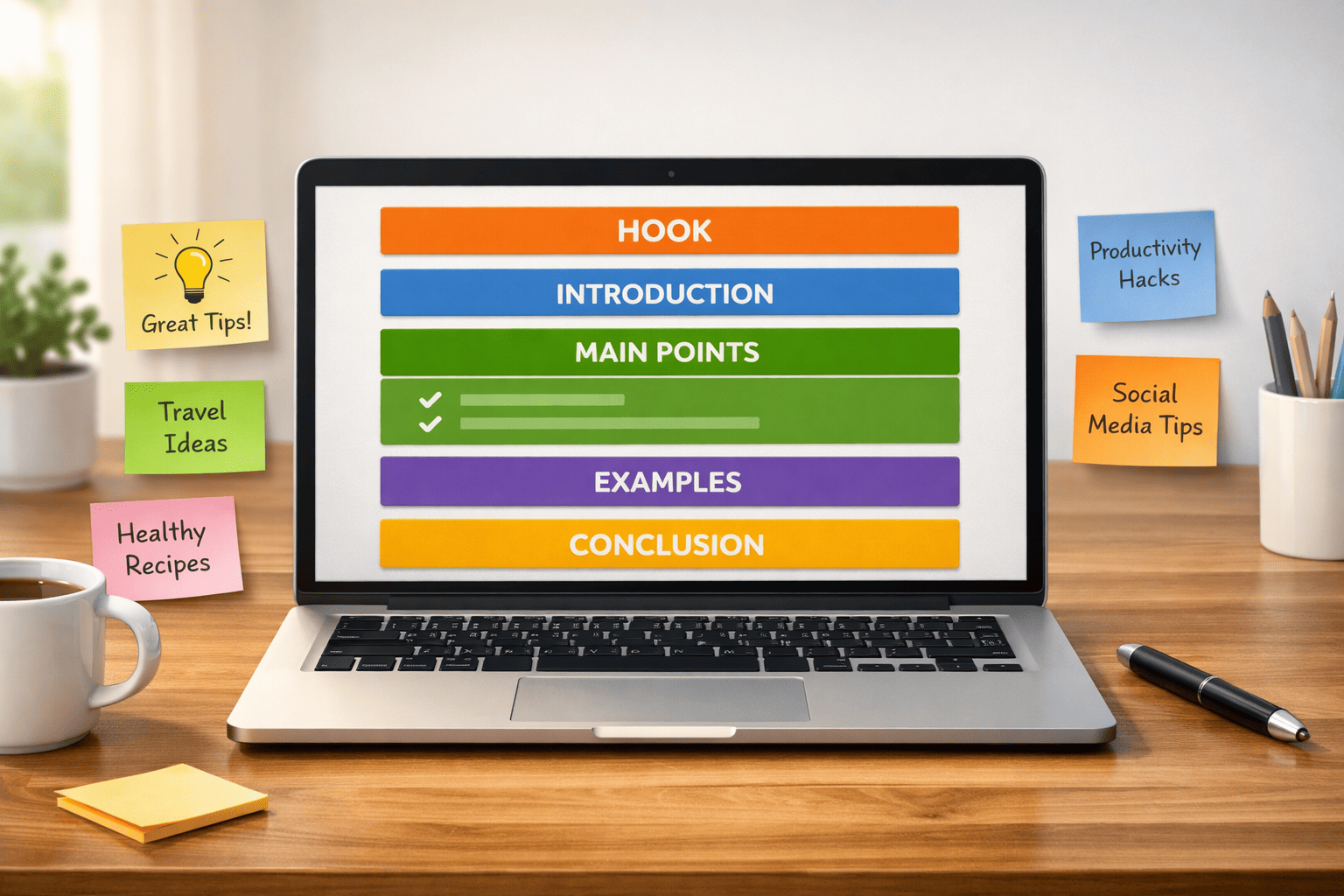
There is a pervasive myth in the content creation world that great writers simply sit down, crack their knuckles, and let the prose flow effortlessly from brain to keyboard. This is a lie. The vast majority of professional writers do not rely on "inspiration"; they rely on architecture.
If you have ever found yourself staring at a blinking cursor for thirty minutes, or if you have published a post that felt "rambly" and unfocused, the problem isn’t your writing ability—it is your process. Consistency in blogging isn’t just about posting on the same day every week; it is about consistency in quality. The secret to that quality is the outline.
An outline is not a cage for your creativity; it is a launchpad. When you have a roadmap, you can drive faster. Here is a simple, repeatable framework to outline your blog posts and ensure that every piece you publish is coherent, valuable, and uniquely "you."
The 4-Part Blog Outline Framework
Every high-performing blog post follows a predictable psychological journey for the reader. This 4-part structure forces your thoughts into a clear, logical progression.
1. The Hook & Thesis (The Introduction)
Your introduction has one primary job: stop the user from hitting the "back" button. Do not waste space with long, winding backstories. Instead, construct your introduction out of three elements:
- The Hook: State a sharp, relatable frustration or a surprising statistic.
- The Problem: Explain why this issue persists (e.g., "Most creators fail because they treat an outline as a rigid script rather than a living roadmap").
- The Thesis: Explicitly state exactly what the reader will learn by finishing the article.
2. The Core Body (The Value Delivery)
Break the main body of your post into 3 to 5 clear subheadings. Forcing a strict numerical constraint on your points keeps your article tight and prevents you from drifting off-topic into unrelated tangents.
For every single point you include in your body, follow this micro-structure:
- The Insight: Introduce the concept or mistake clearly.
- The Context: Explain how this affects the reader’s day-to-day workflow.
- The Action Step: Conclude the section with a prominent, actionable takeaway (e.g., "The Fix:" or "How to apply this:"). Giving the reader an immediate action point makes your content highly scannable and practical.
3. The Bottom Line (The Conclusion)
Never label your final section as a generic "Conclusion"—it reads as dry and predictable. Instead, name it something impactful like "The Bottom Line" or "The Next Step."
Use this section to summarize your argument in a single, memorable sentence. Reiterate that while planning is valuable, the ultimate goal of an outline isn’t absolute perfection; it’s simply clarifying your thinking so you can start executing.
4. The Contextual CTA (Call to Action)
Every piece of content on your domain should serve a strategic purpose. Never leave your reader stranded at the bottom of the page. End your outline with a clear directive:
- Download a template or checklist.
- Read a related, complementary article on your blog.
- Subscribe to a newsletter for more localized insights.
Why This Framework Drives Consistency
When you separate the act of planning from the act of writing, you protect your brain from decision fatigue.
By mapping out your headings, subheadings, and actionable "Fixes" ahead of time, you can verify that your article flows logically and catches structural gaps before you invest hours into writing. When it’s finally time to create, you don’t have to wonder what to say next—you simply look at your blueprint, expand on the bullet points, and comfortably cross the finish line.
Tips for Maintaining Consistency
Using the same structure for every article makes your content more professional.
Some helpful habits include:
- Create reusable outline templates.
- Write headings before writing paragraphs.
- Keep sections similar in length.
- Focus on one idea per section.
- Use clear transitions between topics.
- Review your outline before drafting.
Over time, outlining becomes second nature and significantly speeds up content creation.
Common Mistakes to Avoid
Even experienced writers sometimes skip important planning steps.
Avoid these common mistakes:
- Starting without a clear objective
- Creating too many headings
- Mixing unrelated topics
- Writing paragraphs before organizing ideas
- Ignoring the reader’s questions
- Forgetting a strong conclusion
A few minutes spent outlining can save hours of editing later.
Using AI to Build Better Outlines
Modern AI writing tools can help generate structured outlines in seconds. They can suggest logical headings, organize ideas, recommend FAQs, and identify related subtopics based on your main keyword.
However, AI-generated outlines should always be reviewed and customized to match your audience, brand voice, and content goals. Combining AI assistance with human expertise produces the best results.
Final Thoughts
Consistency is one of the defining characteristics of successful blogs. While inspiration comes and goes, a reliable outlining process ensures every article has a clear purpose, logical flow, and valuable information.
By following a simple framework—defining your goal, organizing key sections, adding supporting points, and ending with a meaningful conclusion—you can write faster, improve quality, and create a better experience for your readers. Whether you’re publishing once a month or every day, a strong outline is the foundation of every effective blog post.