
You have a great idea—or at least the spark of one. It’s swirling around in your head, full of potential, but when you sit down to organize it, you freeze. Do you start with a structured list? Or do you let your thoughts run free on a blank page?
This is the classic dilemma: mindmap vs. outline. Both are powerful tools for brainstorming, but they work in fundamentally different ways. One taps into your brain’s natural, free‑flowing creativity; the other forces that creativity into a logical, sequential structure. The key isn’t to choose a "better" method—it’s to choose the right one for the stage of your project and how your mind works best.
What Is a Mindmap?
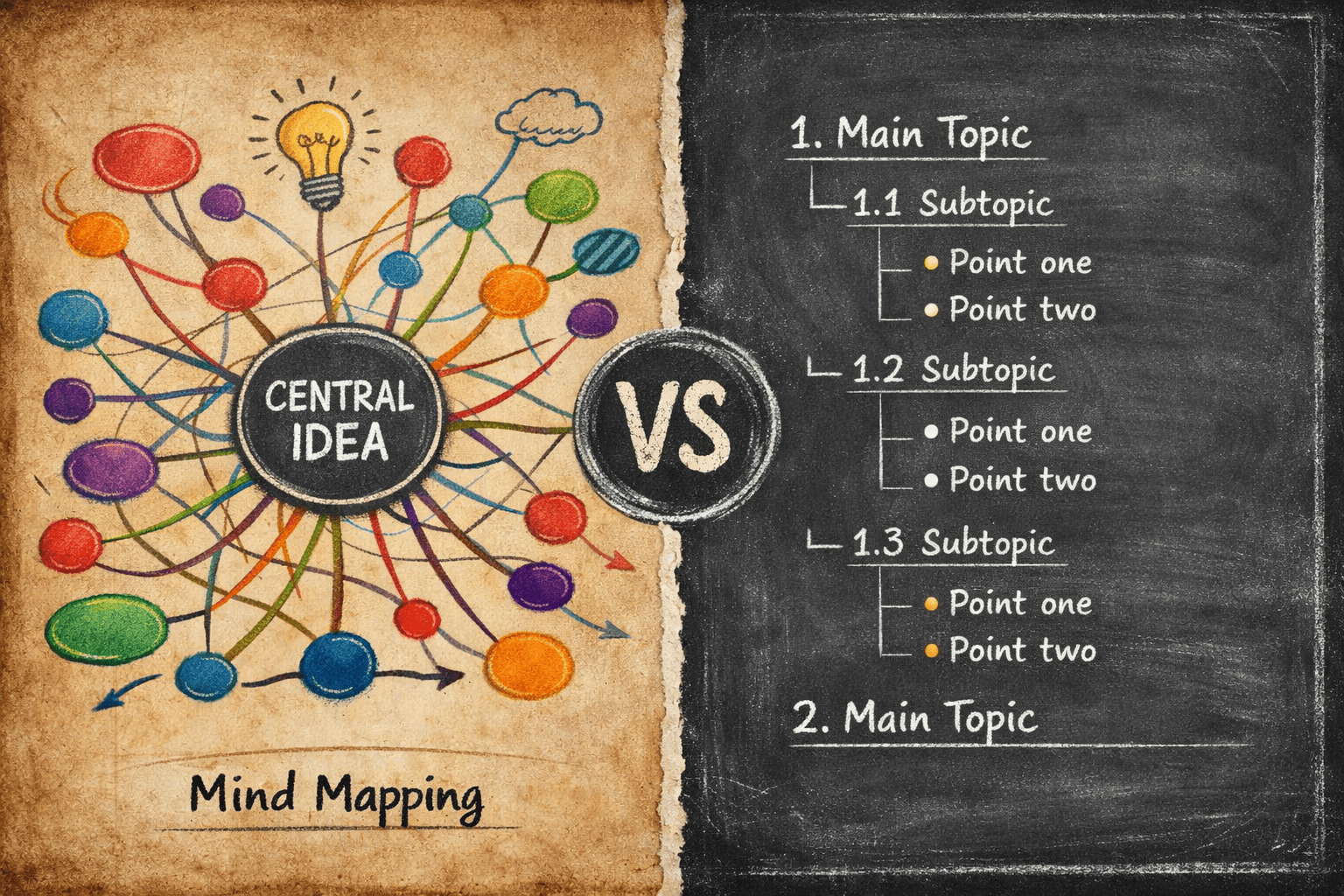
A mindmap is a visual diagram that organizes information around a central topic . Think of it like a tree: the main idea is the trunk, and related subtopics branch out from it. Those branches can split further into more specific ideas, creating a web of interconnected thoughts.
Key features:
- Non‑linear: Ideas are arranged radially, not in a straight line.
- Visual: Uses colors, images, keywords, and connecting lines to represent relationships.
- Flexible: You can easily add, move, or rearrange branches as new ideas emerge.
What Is an Outline?
An outline is a structured, hierarchical list that organizes ideas in a logical, sequential order . It’s like a blueprint for your writing: you start with the main thesis, then break it down into main points, subpoints, and supporting details, often using Roman numerals or decimal notation.
Key features:
- Linear: Ideas flow from top to bottom in a clear sequence.
- Text‑based: Relies on words, not images, to convey information.
- Rigid: The structure is fixed; reorganizing requires more effort than with a mindmap.
The Science: How They Work with Your Brain
The reason these two methods feel so different is that they mirror two distinct modes of thinking.
- Mindmapping mirrors how the brain naturally works. Our thoughts don’t follow a neat, straight line—they jump around between concepts . A mindmap captures this fluidity, encouraging creative, divergent thinking and making it easier to spot unexpected connections. It activates both the logical left side and the creative right side of the brain.
- Outlining, by contrast, is a more analytical and rational tool. It forces you to think sequentially, which is ideal for organizing complex information into a clear, logical argument . It’s the tool of choice for "linear note‑taking" common in meetings and lectures.
Which Is Better for Brainstorming? It Depends on the Stage
Instead of declaring a "winner," think of it as a two‑stage process.
Stage 1: Mindmap for Idea Generation (The Divergent Phase)
Mindmaps excel at the initial, expansive stage of brainstorming. When you’re staring at a blank page, the free‑form nature of a mindmap is invaluable.
- Why it works: You can jot down every idea, no matter how random, without worrying about structure or order. This prevents premature censorship and allows you to explore different paths.
- Best for: Generating new ideas, breaking through creative blocks, exploring complex topics, and seeing the "big picture".
If you’re outlining an essay on renewable energy, a mindmap can help you visualize the entire landscape—branching out into "Solar," "Wind," "Hydro," and connecting them to concepts like "Cost," "Efficiency," and "Environmental Impact".
Stage 2: Outline for Structuring (The Convergent Phase)
Once you have a wealth of ideas, the outline is the best tool to organize them into a logical structure.
- Why it works: It provides a clear, linear framework that ensures your argument flows smoothly and every point has supporting evidence. It’s the blueprint you need for formal projects like essays, reports, or business proposals.
- Best for: Creating a clear sequence of ideas, identifying logical gaps in your argument, and building a cohesive final piece from your brainstormed ideas.
For that same renewable energy essay, you’d use the outline to methodically order your arguments—environmental benefits, economic viability, technological advancements—into a step‑by‑step persuasive argument.
The hybrid approach: Many experts recommend using a mindmap first to explore the terrain, then transitioning to an outline to build the final structure.
How to Choose: A Quick Decision Guide
| Think about... | Choose a Mindmap if... | Choose an Outline if... |
|---|---|---|
| Your goal | You need to generate ideas and explore connections. | You need to organize ideas into a logical sequence. |
| Your project stage | You’re at the very beginning, or feeling creatively stuck . | You have your main ideas and are ready to structure them into a draft. |
| Your preferred thinking style | You’re a visual or non‑linear thinker who likes to see the big picture. | You prefer a logical, sequential approach to organizing information. |
| The project type | You’re brainstorming, planning a narrative, or exploring a complex, multifaceted topic. | You’re writing an argumentative essay, research paper, business report, or a formal document that requires a clear, persuasive structure. |
The Bottom Line: They’re a Team, Not Rivals
Mindmaps and outlines are not enemies, but partners in the creative and organizational process. The mindmap captures the creative storm; the outline builds a shelter out of it.
Starting with a mindmap allows you to explore and connect ideas freely. Switching to an outline gives you the structure and clarity needed to turn those ideas into a coherent finished product. The key to effective brainstorming is knowing when to let your thoughts branch out and when to bring them into line.