
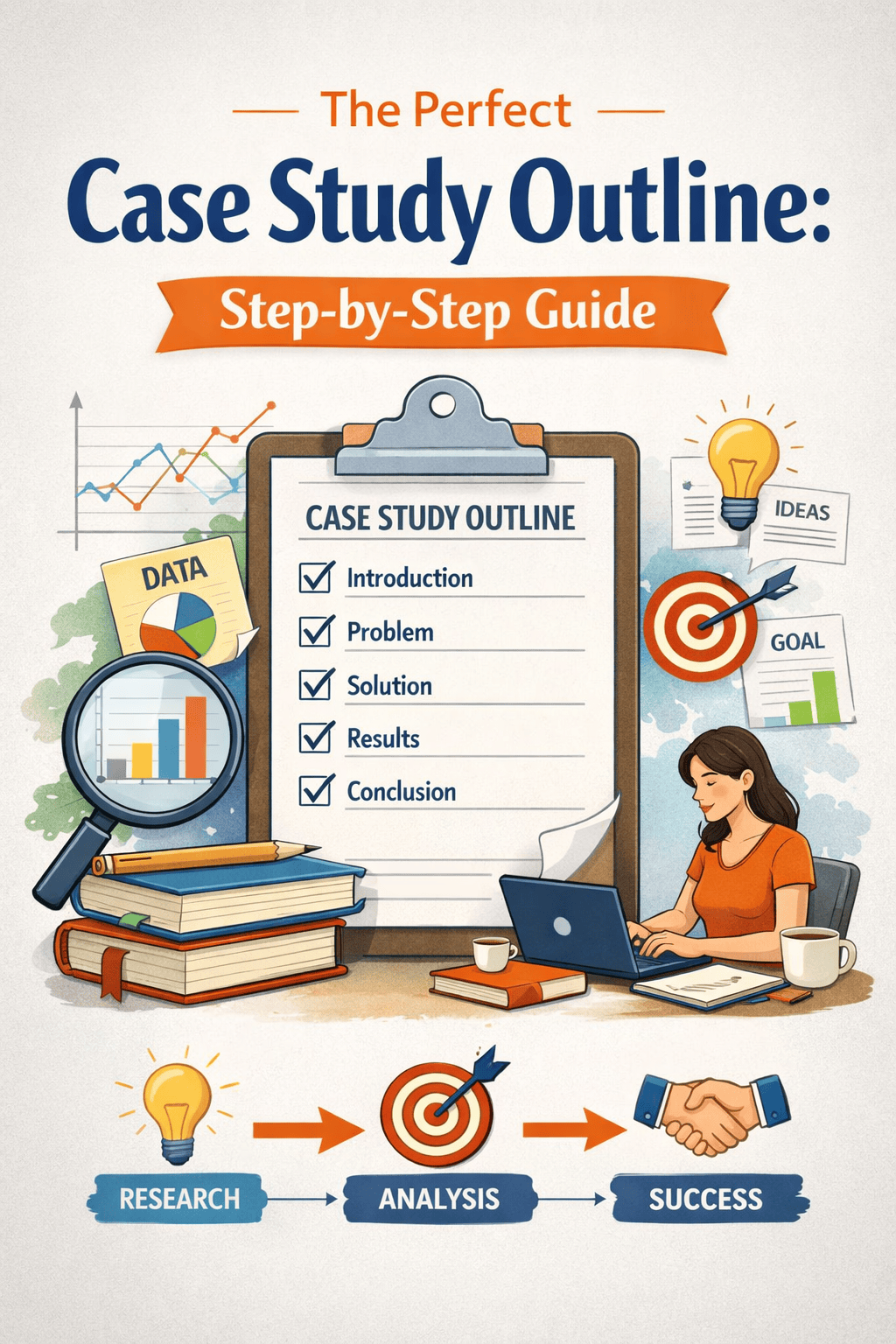
What Is a Case Study?
A case study is a detailed analysis of a real situation, project, campaign, company, or individual experience. It explains:
- The problem or challenge
- The solution implemented
- The process used
- The final results and outcomes
- Business and marketing
- Academic research
- Product development
- Healthcare
- Technology
- Consulting
- Education
Why a Good Case Study Outline Matters
A case study outline acts as the blueprint for your content. It helps you:
- Organize information logically
- Maintain a clear narrative flow
- Highlight important findings
- Keep readers engaged
- Save writing time
- Improve readability
- Increase credibility A poorly structured case study often loses reader attention because it jumps between ideas without clear transitions. A strong outline solves this problem.
- “How a Small Ecommerce Brand Increased Sales by 230% in 6 Months”
- “The Perfect Case Study Outline: Step-by-Step Guide”
- Include measurable results if possible
- Keep it specific
- Avoid vague wording
- The problem
- The solution
- The results
- “A software company struggled with low user retention rates. By redesigning its onboarding process and implementing personalized email campaigns, the company improved retention by 42% within three months.”
- Keep this section short and direct.
- The company, project, or subject
- Industry background
- Market conditions
- Relevant history
- Who is involved?
- What industry are they in?
- What was happening before the problem started?
- The main issue
- Why it mattered
- Its impact on performance or goals
- “The company experienced declining customer engagement due to outdated content marketing strategies.”
- Be specific
- Use data when possible
- Explain consequences
- Increase website traffic
- Improve conversion rates
- Reduce operational costs
- Improve customer satisfaction
- Use measurable goals whenever possible.
- “Increase sales by 20%”
- “Reduce bounce rate below 40%”
- Market research
- Customer surveys
- Data analysis
- Competitor research
- Interviews
- Analytics reports
- It shows that decisions were based on evidence rather than assumptions.
- The strategy chosen
- Why it was selected
- Key tools or methods used
- “The marketing team implemented a personalized email automation system combined with segmented audience targeting.”
- Focus on clarity
- Avoid unnecessary jargon
- Break complex ideas into smaller parts
- Step-by-step actions
- Timeline
- Team responsibilities
- Tools and technologies used
- Conducted customer behavior analysis
- Redesigned email templates
- Created automation workflows
- Launched A/B testing campaigns
- Metrics
- Improvements
- Business impact
- Performance comparisons
- “Revenue increased by 35%”
- “Organic traffic doubled in four months”
- “Customer retention improved by 42%”
- Use charts, percentages, and measurable outcomes whenever possible.
- Recap the challenge
- Highlight the solution
- Emphasize the outcome
- “This case study demonstrates how strategic automation and customer-focused marketing can significantly improve retention and long-term growth.”
The Perfect Case Study Outline
Below is a proven structure you can use for almost any type of case study.
1. Title
Your title should clearly explain what the case study is about while remaining concise and engaging. Good Example:
2. Executive Summary
The executive summary gives readers a quick overview of the entire case study. This section should briefly explain:
3. Background Information
This section provides context for the reader. Explain:
4. Problem Statement
Every great case study revolves around a challenge. Clearly define:
5. Objectives
This section explains what the organization wanted to achieve. Examples:
6. Research and Analysis
Before presenting the solution, explain how the issue was analyzed. This section may include:
7. Proposed Solution
Now explain the strategy or solution developed to solve the problem. This is one of the most important sections in the entire case study. Describe:
8. Implementation Process
Readers want to know how the solution was actually executed. Include:
9. Results and Outcomes
This is where your case study becomes truly persuasive. Show:
Conclusion
The conclusion summarizes the case study and reinforces the key takeaway. A good conclusion should: